QUICK TAKEAWAY
Primary Insight: A professional drain cleaning service removes the blockage and identifies what created it, which is the difference between fixing a drain once and fixing it every few months.
Key Fact: The U.S. EPA lists grease, wipes marked “flushable,” and tree roots among the materials that block sewer lines, and it names routine sewer cleaning and maintenance as a way to prevent the overflows those blockages cause.
Best Suited For: Modesto, Turlock, Ceres, and Stockton homeowners whose drains have slowed more than once, or who have already had one backup.
Most homeowners treat a slow sink as a single event with a single cause, so they reach for a bottle of drain clog remover, apply it, the water goes down, and consider the problem fixed. Then the same drain slows again six weeks later. The clog was never removed; a channel was punched through it, and the material that caused it is still sitting on the pipe wall collecting the next round of debris.
Central Valley homes have specific reasons to take this seriously. Older neighborhoods across Modesto, Turlock, and Ceres sit on original clay or cast iron laterals, shaded by mature trees whose roots spend every summer hunting for the moisture inside those pipes. Add a household that cooks regularly and runs a garbage disposal daily, and the failure is not a question of whether but when.
This guide covers what a professional drain cleaning service actually includes, how the three main methods differ and when each one applies, why store-bought chemicals are the wrong tool, and the specific signals that mean it is time to book service rather than wait.
A professional drain cleaning service is a licensed plumber’s process for removing an obstruction from a drain or sewer line and identifying the cause, using mechanical equipment or high-pressure water rather than chemicals. The service covers both the clearing and the diagnosis. Clearing alone is not the service; it is one step inside it.
The work happens at two different levels of the system. A branch drain serves a single fixture: the kitchen sink, a tub, a bathroom lavatory. The main line, sometimes called the sewer lateral, is the single pipe carrying everything from the house out to the municipal sewer. Which one is blocked determines the equipment, the access point, and the price, and it is the first thing a technician establishes.
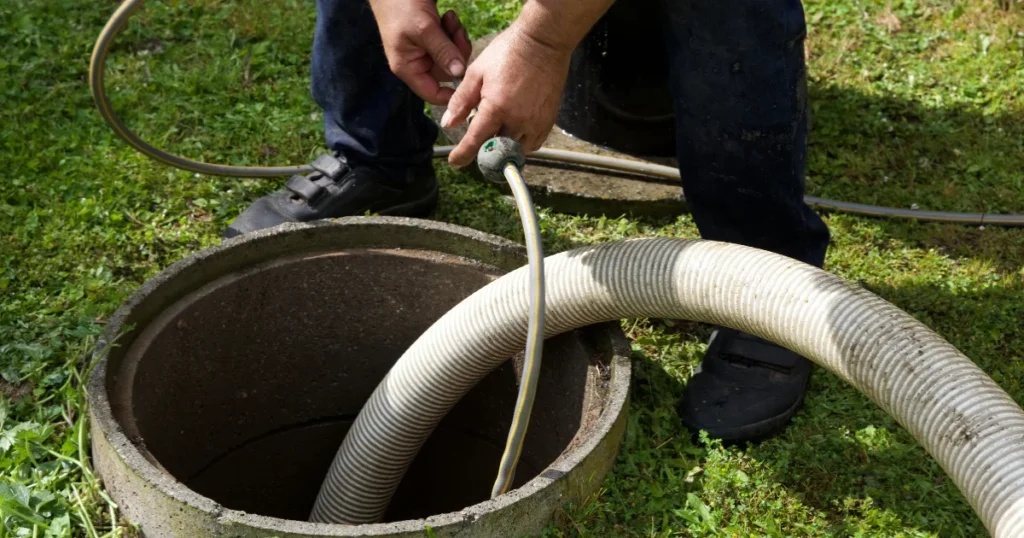
Access is what separates a professional job from a homeowner’s attempt. Rather than working down through a fixture and its trap, a plumber opens a cleanout, which is a capped access port installed specifically so equipment can enter the line in the direction of flow. That is why a professional cable reaches a blockage forty feet out under a lawn and a hardware store snake does not.
A complete visit also ends with verification. After the obstruction is gone, the technician runs volume down the line and watches how it moves, because a drain that accepts a trickle and a drain that accepts a full tub are two different results.
Three tools do nearly all residential drain work, and they are not interchangeable. Cabling clears a path, hydro jetting cleans the pipe wall, and a camera tells you which one the situation calls for.
| Method | What it does | Best for | Limitations |
| Cabling (drain snaking) | Feeds a motorized steel cable into the line and spins a cutting head through the obstruction. | Hair and soap clogs in branch drains, root cutting, restoring flow quickly. | Often bores a channel through buildup rather than removing it, so clogs can return. |
| Hydro jetting | Drives water through a directional nozzle at high pressure to scour the full inside diameter of the pipe. | Grease, sludge, scale, and recurring main line clogs. | Line condition should be confirmed first; not appropriate for badly deteriorated pipe. |
| Camera inspection | Pushes a waterproof video camera through the line to locate and identify the cause on screen. | Repeat clogs, suspected root intrusion, pipe damage, and pre-purchase checks. | Diagnostic only. A camera finds the problem; it does not clear anything. |
The practical rule: cabling is the right answer for a first-time clog in a single fixture, and hydro jetting is the right answer when the same line has clogged before. A cable restores flow through a grease deposit; jetting removes the deposit. If a drain has failed twice, the first tool has already been tried and the result is known.
Chemical drain cleaners are not a substitute for professional drain cleaning because they act on the top of the obstruction, leave the underlying buildup in place, and carry a real injury risk. The National Capital Poison Center notes that non-enzymatic drain cleaners contain highly concentrated corrosive chemicals, including sulfuric and hydrochloric acids or sodium and potassium hydroxide, and that these products are dangerous when used incorrectly or without protective equipment.
The most common injury scenario is also the most common use case. Poison Control specifically flags splash-back from pouring product from too high above the drain, or pouring too much into a drain that is already completely blocked. A fully blocked drain is precisely the situation in which people reach for a second bottle.
The household alternative fares no better. Baking soda and vinegar produces carbon dioxide, but because drains are not airtight, the gas escapes through the drain cover instead of building pressure against the clog, and the mixture is not strong enough to break down oil and grease. It is a reasonable deodorizer and a poor drain opener.
There is a downstream cost as well. When a plumber arrives at a fixture holding several inches of caustic standing water, that water has to be neutralized and removed before any equipment goes in, which adds time to the visit before the actual work starts.
Schedule professional drain cleaning at the second slow drain, not at the first backup. Recurrence is the signal that matters, because a clog that returns is telling you the cause is still in the pipe.
Book service when you notice any of the following:
One clarification worth making: a single slow bathroom sink after a haircut is not a plumbing event. The pattern is what matters, not the incident.
Homes with mature trees or original clay laterals generally benefit from main line service once a year, while newer homes with no backup history can usually run 18 to 24 months between visits. The EPA lists improper or inadequate maintenance and cleaning of sewers among the causes of sanitary sewer overflows, and names routine cleaning among the ways to prevent them.
Two local conditions push Central Valley homes toward the shorter interval.
The first is grease. The City of Modesto warns that fats, oils, and grease poured down a drain stick to the inside of sewer pipes, restrict flow, and eventually cause blockages that back up into homes and storm drains. Grease does not announce itself; it accumulates quietly for years and then fails during a holiday weekend when the kitchen is running hardest.
The second is roots. EPA identifies tree roots entering through defects or openings in a sewer line as a distinct cause of blockages, and older streets throughout Modesto, Ceres, and Turlock are exactly the environment for it: decades-old laterals with joints, under decades-old canopy. Homeowners in those neighborhoods scheduling drain cleaning in Turlock or elsewhere in the 209 are usually managing roots whether they know it or not.
For households that would rather not track this themselves, a maintenance membership such as Care Club puts the interval on someone else’s calendar, which is the practical difference between a schedule and an intention.
A professional visit follows a fixed sequence: diagnose, access, clear, verify, and report. Knowing the sequence makes it easy to tell a thorough visit from a rushed one.
That last step is where the value sits, because a camera sometimes finds a structural problem rather than a clog. A separated joint or a collapsed section is a sewer line repair, not a cleaning, and no amount of cabling will change that. A company that shows you the footage is a company you can check.
Verify licensing before work begins. Plumbing in California falls under the C-36 Plumbing Contractor classification issued by the Contractors State License Board, and CSLB publishes a free License Check tool. Search the company, confirm the license is active and correctly classified, and confirm the bond and workers’ compensation filings are current.
Drains should be professionally cleaned on a schedule that matches the home, generally once a year for houses with mature trees near the sewer lateral or original clay piping, and every 18 to 24 months for newer homes with no history of backups. Households that cook often, run a garbage disposal daily, or have already had one main line clog should stay on the shorter end of that range.
Hydro jetting is safe for older pipes once the line’s condition has been confirmed, which is why a camera inspection normally comes first. Sound cast iron, clay, and ABS lines handle jetting routinely. A line with cracked joints, heavy corrosion, or a collapsed section needs repair rather than cleaning, and a camera is what tells the difference.
Drain cleaning is the service category and hydro jetting is one method inside it. Cabling clears a path through a blockage and restores flow quickly, while hydro jetting scours the full inner wall of the pipe and removes the grease and sludge layer that the cable leaves behind. Jetting costs more and takes longer, and it is the better choice when the same drain has clogged more than once.
A hardware store drain snake cannot reliably clear a main sewer line because consumer cables are too short and too thin to reach a blockage that sits 30 or more feet out under the yard. These tools work on sink and tub traps. When several fixtures back up at once, the obstruction is in the main line, and reaching it takes a sectional or drum machine fed through a cleanout.
Confirming a drain cleaning company’s license in California takes one lookup. The Contractors State License Board maintains a free public License Check tool, and plumbing work falls under the C-36 Plumbing Contractor classification. Search the company name or license number and confirm the license is active, the classification is correct, and the bond and workers’ compensation filings are current before work begins.
The homeowners who spend the least on drains are not the ones with the newest pipes. They are the ones who treated the second slow drain as information instead of an inconvenience, found out whether they were dealing with grease or roots, and put the answer on a schedule.
That is the work Tony’s has been doing across the 209 since 1994: cabling, jetting, and camera inspection under CSLB License #691786, with the finding explained on site rather than summarized on an invoice. Second-generation, family-run, and still the company your Modesto neighbors pass along by name.
If a drain in your home has slowed twice, schedule a visit or call us for professional plumbing services. The Bear would rather find the cause now than pump out your hallway in August.