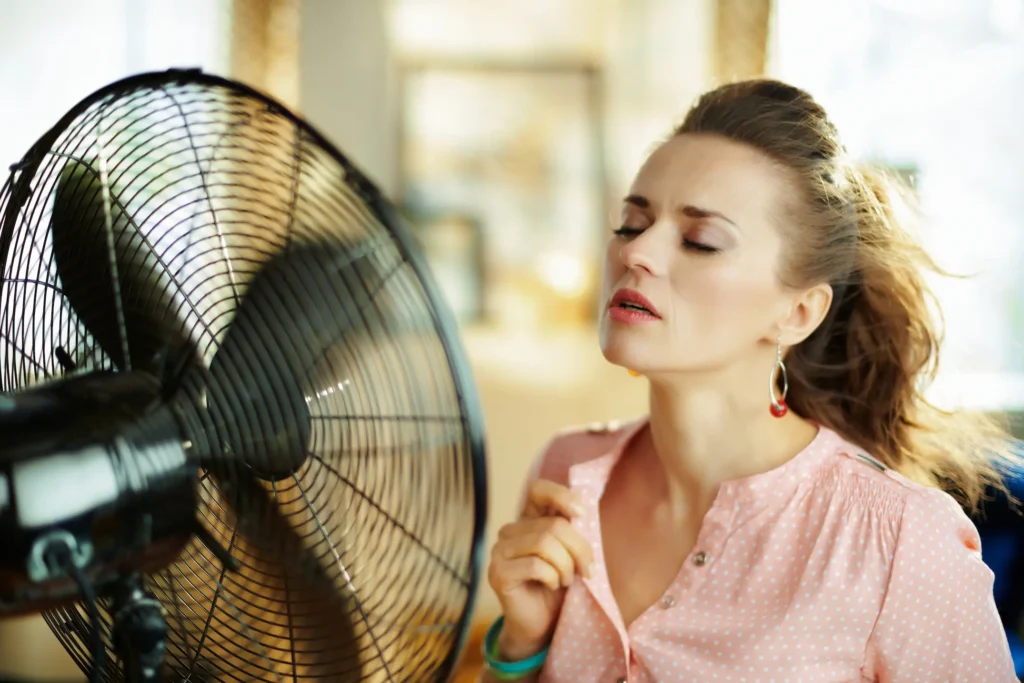
It is the middle of a Central Valley summer, and your air conditioner has been running for two hours straight. You check the thermostat. Still 82 degrees inside. The unit is clearly on, the fan is blowing, but the house is not getting any cooler.
This is one of the most common calls we get in June, July, and August in Modesto and the surrounding area. The problem feels urgent because it is: running an AC that is not cooling wastes energy, puts serious strain on the compressor and other components, and can turn a manageable repair into a full system replacement if ignored long enough.
The causes range from things you can fix in five minutes to problems that require a licensed HVAC technician. This post walks through all of them so you know exactly what you are dealing with before you call.
Before assuming something is broken, rule out the two most common non-mechanical causes. They account for a surprising number of service calls.
Check that the thermostat is set to “Cool” and that the temperature target is actually lower than the current room temperature. If the fan mode is set to “On” instead of “Auto,” the fan will run continuously between cooling cycles, pushing uncooled air through the vents. Switch it to “Auto” and the fan will only run when the system is actively cooling.
If the thermostat display is blank or behaving erratically, replace the batteries. Dead or weak batteries can prevent the thermostat from sending accurate signals to the system and cause the kind of erratic behavior that looks like a mechanical failure.
A clogged air filter is the single most common cause of an AC that runs without cooling effectively. When the filter is blocked, airflow through the system drops, and the unit has to work harder and longer to move the same amount of air. The U.S. Department of Energy states that replacing a dirty filter with a clean one can reduce your air conditioner’s energy consumption by 5 to 15 percent. In extreme cases, restricted airflow causes the evaporator coil to freeze over, which stops cooling entirely.
Check your filter and hold it up to a light source. If you cannot see light through it, replace it. During summer in the Central Valley, where dust, pollen, and dry air are constant, most filters need replacement every one to two months rather than the standard three-month cycle.
If the filter is clean but the AC still is not cooling, check the indoor air handler for ice or frost buildup. A frozen evaporator coil is one of the most visible signs that something is restricting airflow or causing the refrigerant to expand incorrectly.
When airflow drops below what the coil needs, the refrigerant inside it gets too cold and freezes the condensation collecting on its surface. Once ice forms, the coil cannot absorb heat from the air, and your system blows room-temperature air regardless of how long it runs.
The immediate fix: turn the system off and set the thermostat fan to “On” only (not “Cool”). This lets warm air circulate and thaw the coil without the compressor running. The thaw typically takes one to three hours. Once thawed, check and replace the filter before turning the system back on. If the coil freezes again after the filter is replaced, there is an underlying refrigerant or airflow problem that requires professional diagnosis.
The outdoor condenser unit is where your AC releases the heat it pulled from inside your home. The coil on the outside of the unit has to shed that heat into the outdoor air to complete the cooling cycle. In the Central Valley, where dust and organic debris are constant, this coil gets coated in grime faster than in most other regions.
A condenser coil that is heavily fouled cannot release heat efficiently. The system runs longer trying to complete the cooling cycle but never fully gets there, which drives up electricity use and puts excessive wear on the compressor.
You can do a basic visual check: look at the condenser fins around the outside of the unit. If they are visibly caked with dirt, dust, or cottonwood, carefully rinsing them with a garden hose (from the inside out, if possible) can restore airflow. Clear at least two feet of space around the unit so vegetation is not restricting airflow. If the coil is heavily fouled or the fins are bent, a technician’s cleaning and fin comb are more effective than a DIY rinse.
Refrigerant is the substance that actually transfers heat out of your home. It cycles between the indoor evaporator coil and the outdoor condenser coil, changing from liquid to gas and back, absorbing and releasing heat at each stage. When refrigerant is low, the system loses the capacity to pull heat from the indoor air regardless of how long it runs.
Refrigerant does not get used up over time. If the level is low, there is a leak somewhere in the system. Common signs include a system that runs constantly without reaching the set temperature, ice on the refrigerant lines or evaporator coil, a hissing or bubbling sound near the indoor or outdoor unit, and humidity levels inside the house that feel higher than usual even with the system running.
Handling refrigerant requires EPA Section 608 certification and specialized equipment. It is not a DIY repair. A licensed HVAC technician will locate the leak, repair it, and recharge the system to the correct pressure. Simply adding refrigerant without fixing the leak is a temporary measure that masks the problem and allows ongoing system damage.
The capacitor is a small cylindrical component that provides the electrical jolt needed to start the compressor and the fan motors. Capacitors are heat-sensitive, and they are one of the most commonly replaced AC parts in regions like the Central Valley where outdoor temperatures regularly exceed 100 degrees Fahrenheit.
When a capacitor is failing, you may notice the outdoor unit humming but not fully starting, the fan running sluggishly, or the system short-cycling: starting briefly, shutting off, and starting again. In some cases, the compressor will not start at all while the indoor air handler continues to run, giving you the impression the system is on when only the fan is operating.
Capacitor replacement is a relatively affordable repair when caught early. A failed capacitor that causes the compressor to strain repeatedly, however, can lead to compressor failure, which is one of the most expensive AC repairs possible. If your system is exhibiting any of the behaviors above, having a technician check the capacitor is a reasonable first step.
An undersized AC unit will run continuously because it genuinely cannot keep up with the cooling load of the home. This is most obvious on the hottest days of the year, when an adequately sized system might cycle on and off and an undersized one simply never shuts off. If your system runs nonstop during mild weather as well as extreme heat, the cause is more likely a maintenance or mechanical issue. If it only runs continuously when temperatures spike above 100 degrees and cools acceptably otherwise, sizing may be a factor.
The right size for your home is determined by a Manual J load calculation that accounts for square footage, insulation, window placement, orientation, and local climate data. In the Central Valley, where summer temperatures are extreme and homes vary significantly in construction quality, a proper sizing assessment matters more than in milder regions.
Central air conditioning systems have a typical service life of 15 to 20 years. As a system ages, individual components lose efficiency, refrigerant lines and coils develop slow leaks, and the compressor works harder to achieve the same output. An older system that ran fine for years may start running continuously because its collective efficiency has declined to the point where it can no longer maintain a set temperature under load.
If your system is more than 15 years old and requiring frequent repairs alongside running without cooling, replacement by a certified AC repairman is worth evaluating. A modern unit with a high SEER2 efficiency rating will cool more effectively, use significantly less electricity, and carry a manufacturer’s warranty that older equipment cannot match.
Work through the checks in order. Start with the thermostat settings and filter. If those are fine, look at the outdoor unit for obvious debris and check the indoor unit for ice. If you find ice, shut the system down and let it thaw before restarting.
If none of the accessible checks resolve the issue, shut the system off and call your local HVAC technician rather than continuing to run it in a degraded state. Running a system with a refrigerant leak, a failing capacitor, or a frozen coil can escalate a moderate repair into a major one. In Central Valley summer heat, the impulse is to keep the system running no matter what, but a compressor that fails from sustained strain is a much bigger expense than the repair that could have prevented it.
Tony’s Care Club members get priority scheduling during peak summer months, which matters when every HVAC company in Modesto is booked out during a heat wave. If you are not already a member, visit our Care Club page to see what is included.
If the system has been running for more than two hours without making measurable progress toward the set temperature, something is wrong. Do not leave it running indefinitely. Shut it down once you have confirmed the basics (filter, thermostat settings, visible ice) and call for service. Prolonged operation in a compromised state causes accelerating wear.
No. Refrigerant handling requires EPA Section 608 certification. Purchasing refrigerant without a license is illegal for residential use, and adding refrigerant without repairing the underlying leak only delays the problem. A licensed technician must diagnose the leak, repair it, and recharge the system.
Sudden loss of cooling performance usually points to something specific: a filter that got clogged faster than expected during a dusty period, a refrigerant leak that reached a critical low, a capacitor that finally gave out, or debris that accumulated on the condenser during a wind event. These problems tend to cross a threshold where they go from manageable to failure relatively quickly, which is why the system can seem fine one day and ineffective the next.
It depends on the cause and the age of the system. A clogged filter, dirty coil, or failed capacitor on a system under 12 years old: repair is almost always worth it. Compressor failure or refrigerant leaks on a system over 15 years old: replacement is often more cost-effective over a five-year horizon, particularly given the efficiency gains from modern equipment. A technician can give you an honest assessment once the cause is diagnosed.
Heat amplifies every existing inefficiency in your system. A dirty coil that copes adequately at 85 degrees fails at 105 degrees. A low-capacity capacitor that starts the compressor in mild weather cannot provide the extra voltage needed under peak load. Summer heat also increases the cooling demand your home places on the system, pushing an already-stressed unit past its limit. This is why June through September is when these problems surface, even if the underlying issue has been developing since winter.
Your air conditioner running nonstop without cooling the house is not a quirk to wait out. It is a signal that one or more parts of the system are not working as they should, and the longer it runs in that state, the more the problem compounds.
Most of the causes covered here are repairable at reasonable cost when caught early. Frozen coils thaw. Dirty coils get cleaned. Capacitors get replaced. Refrigerant leaks get repaired and recharged. What turns a moderate repair into a system replacement is time: running a compromised system through a Central Valley summer until a stressed compressor gives out.
Tony’s Plumbing, Heating and Air serves Modesto, Turlock, Stockton, Ceres, and the surrounding Central Valley. If your AC is running but not cooling, call us for emergency service or schedule your service here. We offer same-day service when available and an honest diagnosis before any repair.